

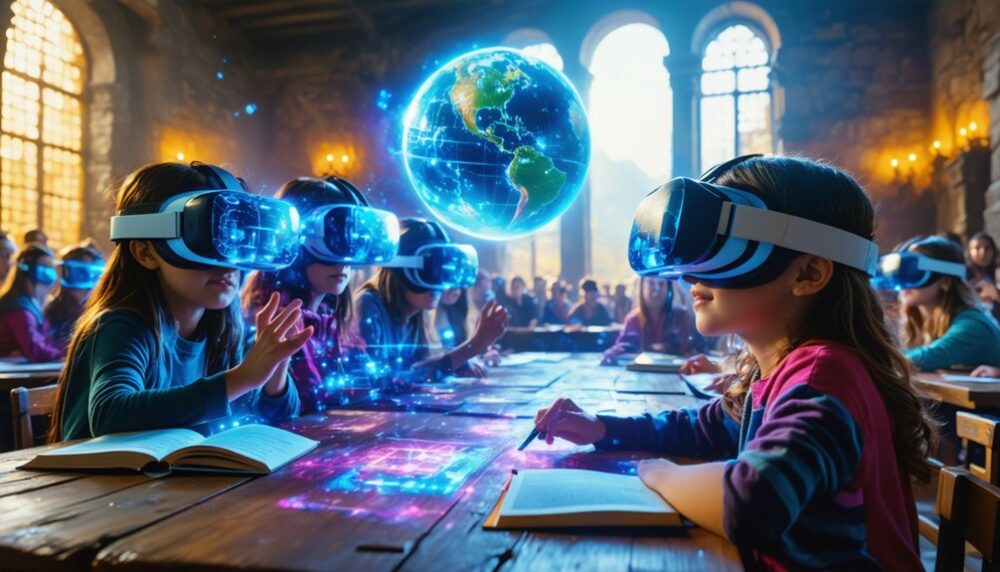

Virtual reality (VR) is revolutionizing classroom learning by offering immersive experiences that enhance engagement and nurture personalized educational pathways. Students benefit from substantially improved retention rates and faster skill acquisition, with VR learners achieving average exam scores of 93%. This technology builds confidence in students, enabling them to practice skills in low-stress environments. Despite implementation challenges, the growing market for VR signals its revolutionary potential. Uncover how VR continues to shape the future of education as it evolves.
Highlights
- Virtual reality enhances learning effectiveness, resulting in significantly higher exam scores and improved knowledge retention compared to traditional methods.
- VR provides personalized learning experiences that foster confidence and allow students to engage in practical skills training without the pressure of real-world consequences.
- Immersive environments in VR support social learning, enabling collaborative interactions and emotional engagement, which are critical for academic success.
- Real-time performance tracking in VR allows for accurate assessments of practical abilities, catering to a growing demand for alternative evaluation methods.
- As VR technology becomes more cost-effective, it promises to reduce training times and operational costs significantly compared to traditional classroom setups.
The Growing Market for VR in Education
As the educational scenery evolves, the market for virtual reality (VR) in education has emerged as a thriving sector positioned for outstanding growth. The industry outlook signifies a notable trajectory, with projections estimating the market’s value to surge from USD 16.76 billion in 2024 to USD 86.84 billion by 2034, reflecting a sturdy CAGR of 17.88%. Alternatively, some analyses predict growth rates as high as 30.7%, potentially reaching USD 28.70 billion by 2030. Especially, North America presently leads in market share, while the Asia Pacific region is set to experience the highest growth due to substantial government funding. The largest segment of the VR Education market is particularly focused on industrial and corporate training. Advancements in display technology are also contributing to the growth of immersive learning experiences, as market trends indicate a strong preference for standalone headsets, highlighting the growing demand for immersive learning tools in academic and corporate settings.
Enhanced Learning Effectiveness and Retention
While traditional classroom settings have long been the cornerstone of educational practices, the integration of virtual reality (VR) is reshaping the terrain of learning effectiveness and retention. Research indicates that VR facilitates personalized learning experiences, allowing students to engage with interactive lessons in unparalleled ways. This innovative approach leads to substantially improved academic performance, with VR learners achieving average exam scores of 93%, a phenomenal 20-point increase over traditional methods. Additionally, participants in VR environments boast an 8.8% higher recall rate, showcasing enhanced memory retention. Moreover, virtual reality has been shown to improve spatial visualization skills, further contributing to students’ overall cognitive development. By providing immersive experiences, VR allows learners to understand subject matter and relate to it in a meaningful way. Furthermore, VR promotes cognitive engagement by enabling students to explore knowledge in deeper and more varied ways, thereby fostering intrinsic motivation and active participation in the learning process.
Accelerated Learning Speed and Efficiency
The integration of virtual reality (VR) in educational settings not only enhances learning effectiveness and retention but also substantially accelerates the speed and efficiency of learning processes. This innovative approach utilizes personalized learning through adaptive technology, tailoring experiences to individual needs. Studies show that VR can reduce training time dramatically, with platforms like Delta Airlines achieving a 5,000% efficiency gain. For instance, VR learners can grasp identical content in just 29 minutes, compared to two hours in traditional classrooms. Additionally, cognitive efficiency improves substantially, facilitating 25% faster skill application. AI in education is predicted to improve learning outcomes by 30% for each student, underscoring the broader potential of emerging technologies in enhancing educational impacts. Furthermore, research indicates that VR-trained students achieved better exam pass rates than those in traditional study environments. With immersive experiences promoting deeper engagement, educational institutions welcome VR, demonstrating that it can revolutionize how quickly and effectively students acquire knowledge in interactive, fast-paced environments.
Building Confidence and Skill Development
Utilizing virtual reality (VR) in educational settings promotes significant advancements in both confidence and skill development among learners. Research indicates that 67% of students experience heightened confidence after engaging with VR simulations, while those trained in VR exhibit a noteworthy 275% increase in the confidence to apply their skills. Moreover, VR facilitates social learning and personalized instruction by providing immersive environments that allow learners to practice in low-stress scenarios. This approach not only enhances retention but also supports skill proficiency; welding students trained with VR achieved 100% superior test performance. With 95% of learners feeling better prepared for real-world applications, VR stands as a groundbreaking tool, increasing job placement rates by providing students a competitive edge in the job market. Furthermore, high-immersion VR has shown potential to enhance learning in various fields, reinforcing the importance of technological integration in education. Thus, VR undergoes a profound change to become a more effective learning aid, revolutionizing the learning process to produce a more skilled expert. Research has clearly shown that VR leads to improved learning retention, which further solidifies its value in educational settings.
Transforming Assessment Methods in Education
A revolutionary shift is occurring in educational assessment methods, driven by the integration of virtual reality (VR) technology. This transformation supports personalized learning by allowing students to engage in simulated environments that replicate real-life situations, enabling them to apply critical thinking and decision-making skills. A significant 74% of teachers affirm that VR-powered assessments effectively evaluate practical abilities, while 62% of parents demand alternatives to traditional testing, reflecting a shared desire for more meaningful evaluations. Real-time performance tracking within these immersive virtual workspaces captures detailed student actions, promoting accurate competency assessments. This innovative approach not only enhances engagement but also nurtures authentic skill development across various disciplines, clearing a path for a more inclusive, effective educational terrain. The effectiveness of VR as a learning tool is recognized by educational accreditation bodies, ensuring that these methods meet rigorous standards for assessing student performance. Moreover, the immersive nature of VR enhances critical thinking skills, resulting in improved problem-solving abilities among students engaged in these assessments. As evidenced by statistics, VR adoption in UK schools is expected to rise by 35% in the coming year, indicating growing recognition of its benefits.
Overcoming Implementation Challenges
While the promise of virtual reality (VR) in classroom learning is substantial, numerous challenges hinder its seamless implementation in educational settings. Technical support and infrastructure development play crucial roles in traversing these obstacles. Many educators feel unprepared for immersive technology, as a staggering 64% lack adequate training. Additionally, many educational institutions are unsure about adopting VR, which complicates the transition to this innovative technology.
With VR headset prices decreasing, accessibility improves, yet budget constraints may limit quality content development. Additionally, health concerns like motion sickness can deter usage, disproportionately affecting female students. To overcome these challenges, schools must prioritize comprehensive training programs and strategic investment in VR infrastructure, ensuring equitable access. Moreover, the impact of VR can transform not just individual learning experiences, but also how collaborative learning occurs in the classroom. Furthermore, lack of standardization across VR/AR platforms complicates the integration process, highlighting the necessity for cohesive systems and guidelines.
As VR education continues to evolve, a collaborative effort among educators, administrators, and developers will be essential to realize its full potential in enhancing student learning experiences, and this effort will be a critical aspect in making VR education a staple, thus a strong initiative will be necessary to address the limitations and ensure strong foundations for its implementation.
The Role of Emotional Engagement in Learning
Educational technology, such as virtual reality, can create immersive experiences that enhance learning and promote emotional engagement among students. Emotional engagement reflects students’ feelings about school and their peers, nurturing a sense of belonging and supporting student motivation. Positive interactions, emotional safety, and engaging activities influence the emotional responses that drive academic performance. When students feel connected to their environment, they are more likely to participate actively and take risks in their educational path. Additionally, emotional engagement positively correlates with improved memory retention and academic satisfaction. Furthermore, blended learning has been shown to significantly amplify the impact of emotional engagement on academic outcomes. The ability to effectively regulate emotions is essential for students to navigate challenges, further enhancing their engagement and learning experiences. Importantly, behavioral engagement plays a crucial role in fostering emotional connections, as consistent participation and positive classroom interactions enhance students’ overall sense of belonging.
Cost Analysis of VR Training vs. Traditional Methods
The growing adoption of virtual reality (VR) training in educational settings prompts a thorough analysis of its cost compared to traditional methods. Initial investments for VR can be high, ranging from $10,000 to over $500,000 depending on the complexity of the solutions.
However, budget planning reveals significant long-term cost savings. Once 375 learners are trained, VR achieves cost parity with traditional classrooms, and at 3,000 learners, it becomes 52% more cost-effective. Additionally, operational efficiencies arise from reduced travel and facility costs, while immersive training can decrease time and increase retention rates.
Ultimately, as educational institutions accept VR, careful cost analysis will demonstrate its potential to reshape financial strategies while enhancing learning outcomes. Additionally, operational efficiencies lead to reduced costs and improved outcomes.
The Future of VR in Classroom Settings
As virtual reality (VR) technology continues to evolve, its integration into classroom settings promises to revolutionize traditional learning environments fundamentally. The market for VR in education is projected to grow substantially, reflecting the increasing need for immersive education approaches that engage students more effectively.
By 2030, the VR education market alone is expected to reach $28.70 billion, highlighting substantial investment in virtual classrooms. Moreover, VR enhances learning effectiveness, demonstrated by increases in knowledge retention and speed of course completion. Teachers and parents alike are recognizing its potential to better evaluate real-life skills, nurturing a richer educational experience.
As these advancements unfold, the future of VR in classroom settings appears increasingly promising, connecting diverse learners through innovative educational methodologies, and also, VR technology will also plunge into more educational areas.
References
- https://www.classvr.com/resource-hub/blog/transforming-learning-environments-3-examples-of-ar-education/
- https://virtualspeech.com/blog/vr-stats-training-education
- https://www.gostudent.org/en-gb/blog/virtual-reality-in-education-statistics
- https://www.takeaway-reality.com/post/vr-training-and-vr-education-statistics-2024
- https://skillsvr.com/virtual-reality-training-stats-for-2025-learning-across-industries
- https://www.frontiersin.org/journals/education/articles/10.3389/feduc.2025.1560626/full
- https://www.devlinpeck.com/content/online-learning-statistics
- https://forwork.meta.com/blog/vr-immersive-learning-improving-education/
- https://edtechmagazine.com/k12/article/2025/09/schools-set-their-sights-vr-learning-opportunities
- https://www.intellectualmarketinsights.com/blog/top-companies-leading-in-the-global-virtual-reality-vr-in-education-market-2025