

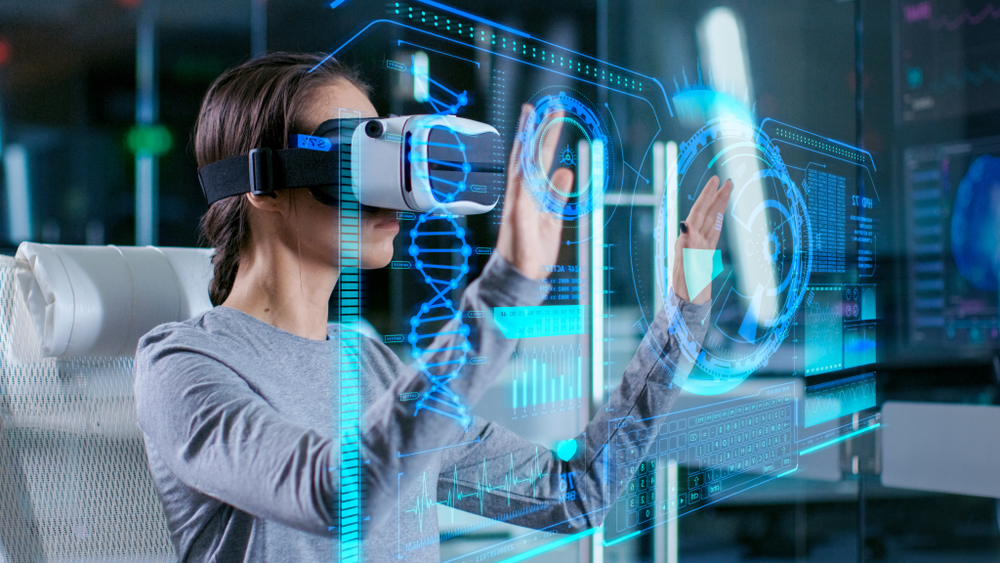

Virtual reality is revolutionizing science education by offering immersive experiences that enhance student understanding and retention. Engaging simulations enable learners to investigate complex concepts, such as human anatomy or astronomical phenomena, in a visceral way. With evidence showing that VR training improves learning outcomes substantially, more educational institutions are adopting this technology. As students actively participate in virtual environments, science becomes more tangible and exciting. This evolution in education hints at even greater advancements on the horizon.
Highlights
- VR immerses students in interactive science environments, enhancing comprehension and retention of complex concepts by up to 75%.
- Experiential learning in VR allows learners to explore abstract scientific ideas in engaging, hands-on ways, promoting up to 90% recall.
- Teachers recognize VR’s effectiveness, with 93% reporting improved student engagement and understanding in science education.
- Customized VR experiences cater to diverse learning needs, including those with disabilities, ensuring all students can participate in science exploration.
- Collaborative VR simulations encourage teamwork and communication skills, essential for scientific inquiry and innovation.
The Rapid Growth of VR in Education
As the scenery of education evolves, the integration of virtual reality (VR) is becoming increasingly significant, particularly due to its promising market growth and revolutionary potential.
The global VR education market, valued at $16.13 billion in 2024, is projected to skyrocket to $86.96 billion by 2029, driven by a remarkable 40.6% compound annual growth rate (CAGR). This growth is largely attributed to the rising demand for immersive learning experiences that institutions are beginning to recognize. Furthermore, significant investments are being made in VR hardware and software development aimed at educational applications.
Key market trends highlight the rising adoption of immersive learning experiences and a surge in research and development investments. Funding strategies are vital, with significant public and private investments aimed at creating engaging educational VR content. Additionally, classroom technology innovation is fostering new opportunities for effective learning environments.
Corporate training remains the largest segment, with institutions recognizing the groundbreaking potential of VR to enhance learning and nurture engagement, creating a sense of belonging for all participants, and harnessing its revolutionary capacity to reshape and revamp educational experiences, driving a pivotal and revolutionary change.
Enhancing Learning Effectiveness With VR
The integration of virtual reality (VR) in educational settings is driving a metamorphosis in learning effectiveness that traditional methods struggle to match. Research demonstrates that VR-trained students consistently outperform their peers in exhaustive exams, achieving higher pass rates across various group sizes. This immersive medium enhances skill-specific mastery, particularly in complex subjects like anatomy and surgery, where enhanced spatial understanding is critical. Additionally, VR environments promote improved retention of abstract concepts, with experiential learning yielding up to 90% recall. Personalized and adaptive experiences, such as intelligent tutoring and customized assessments, allow learners to control their pacing while effectively bridging theoretical knowledge with real-world applications. Recent studies show that VR training represents a revolutionary approach to modern education, promoting deeper connections and collaborative learning, and has the power to revolutionize and change the learning process, offering an all-encompassing and thorough educational experience. Furthermore, the ability of VR to visualize abstract concepts makes it particularly effective in science education, where understanding complex relationships is essential. This technology’s capacity to improve student engagement highlights its transformative potential within educational frameworks, particularly in facilitating cognitive and affective dimensions of learning.
Boosting Student Engagement Through Immersion
Immersive technologies, particularly virtual reality (VR), are proving to be powerful catalysts for enhancing student engagement within educational surroundings. With 93% of teachers recognizing VR’s effectiveness in science exploration, students are drawn into interactive experiences like exploring the moon or examining a human heart. These virtual interactions not only ignite excitement but also build detailed mental maps, improving knowledge retention by up to 75%. As schools increasingly adopt VR—projected to rise by 35% in the UK by 2024—students from diverse backgrounds, including those with learning disabilities, benefit from these customized immersive experiences. Furthermore, this technology provides opportunities for students with limited mobility or accessibility issues to participate in interactive learning experiences. Ultimately, VR revolutionizes traditional learning models, elevating student engagement and nurturing a deeper connection to scientific inquiry in an inclusive environment. Additionally, experiential learning with VR significantly enhances students’ ability to recall information.
Transforming Science Education With Virtual Experiences
A modern age of science education is emerging, fueled by the capabilities of virtual reality (VR) technology. Virtual Labs offer immersive environments where students can engage in Science Simulations, substantially enhancing their understanding.
Research indicates that learners in VR settings achieve higher scores than in traditional classrooms, demonstrating a strong effectiveness in promoting cognitive skills. VR’s multi-sensory interaction promotes better knowledge retention and recall, while customized VR content enables students to grasp complex concepts, like molecular structures, with ease. However, to maximize these benefits, educators must traverse integration challenges and receive proper training. Teachers’ attitudes can significantly influence the effective integration of VR in science education. By cultivating these immersive experiences, VR has the potential to make science education vivid and engaging, creating a sense of belonging in the scientific community for all learners.
Addressing Demographic Disparities in VR Adoption
While the potential of virtual reality (VR) to enhance educational experiences is undeniable, significant demographic disparities exist in its adoption, which must be addressed to guarantee equitable access across various groups. A stark gender gap, with 30% of men versus 16% of women trying VR, highlights the need for targeted outreach. Age-related adoption is also evident, as younger generations, particularly Gen-Z, dominate usage while older adults lag behind. Socioeconomic barriers further exacerbate access inequality, with concerns about privacy and biometric data deterring potential users. Furthermore, 45% of VR users are Gen-Z, indicating that focusing on this demographic could help bridge the adoption gap among younger audiences. In addition, studies have shown that VR technology can be effectively utilized in educational settings without significant gender disparity. Notably, the virtual reality market is projected to reach USD 57.55 billion by 2027, underscoring the potential for broader adoption across demographics.
Innovative Institutional Initiatives in VR Development
As educational institutions increasingly recognize the revolutionary potential of virtual reality (VR), innovative initiatives are emerging to enhance both training and learning experiences, and in the process, revolutionize them.
Institutions are leveraging VR as a platform for virtual innovation across various sectors, from healthcare to retail. For instance, Walmart employs VR for training customer service and emergency protocols, while healthcare institutions like Johns Hopkins utilize VR for surgical simulations, substantially improving performance outcomes. Moreover, data indicates a surge in the adoption of cloud-based platforms, enabling scalability and remote access to sophisticated simulations. Furthermore, over 75% of Fortune 500 companies are already integrating VR into training processes, showcasing its growing relevance in the corporate sphere. Additionally, 30% of Gen Z and millennials utilized VR technology for educational purposes, reflecting its effectiveness in engaging younger audiences.
Additionally, collaborative learning environments enable students to engage in immersive multi-user simulations, nurturing essential communication skills. These research initiatives demonstrate a commitment to developing standardized VR training modules that enhance global learning, ensuring that students and professionals alike benefit from state-of-the-art technology in their fields, and in addition, they employ this technology.
The Future of Virtual Reality in the Classroom
The future of virtual reality (VR) in the classroom promises to revolutionize educational experiences by providing immersive, interactive learning environments that engage students in unparalleled ways. With the VR education market projected to grow from $4.4 billion in 2023 to $28.7 billion by 2030, educational technology is set to become integral to digital classrooms. Enhanced learning effectiveness is notable, with VR improving outcomes by 76% and allowing students to gain mastery skills four times faster than traditional methods. High interest from 97% of students indicates a strong desire for VR integration. As schools investigate immersive simulations across various subjects, the potential for personalized, engaging curricula guarantees that future generations will thrive in their educational paths, nurturing a sense of belonging and confidence. This growing demand for VR training reflects the significant impact it can have on modern education. Moreover, the number of US jobs utilizing AR or VR is projected to reach 2.32 million by 2030, demonstrating the increasing relevance of these technologies in shaping future careers. The Virtual Reality in Education Market is expected to exhibit a CAGR of 22.22% from 2025 to 2034, indicating a robust future for VR in educational settings.
Conclusion
To summarize, virtual reality is revolutionizing science education by enhancing engagement and learning effectiveness. As institutions increasingly adopt innovative VR technologies, they cultivate immersive experiences that make complex scientific concepts accessible and enchanting for students. Addressing existing demographic disparities guarantees that the benefits of VR are equitable, clearing a path for a more inclusive educational terrain. Looking ahead, the continued integration of VR in classrooms promises to reshape how science is taught, inspiring future generations of learners.
References
- https://www.matsh.co/en/statistics-on-ai-vr-adoption-in-education/
- https://files.eric.ed.gov/fulltext/EJ1400500.pdf
- https://virtualspeech.com/blog/vr-stats-training-education
- https://pmc.ncbi.nlm.nih.gov/articles/PMC11040080/
- https://tmb.apaopen.org/pub/6efbojus
- https://www.thebusinessresearchcompany.com/market-insights/virtual-reality-in-education-market-insights-2025
- https://www.archivemarketresearch.com/reports/virtual-reality-for-education-564444
- https://www.intellectualmarketinsights.com/blog/top-companies-leading-in-the-global-virtual-reality-vr-in-education-market-2025
- https://www.takeaway-reality.com/post/vr-training-and-vr-education-statistics-2024
- https://pmc.ncbi.nlm.nih.gov/articles/PMC7940910/