

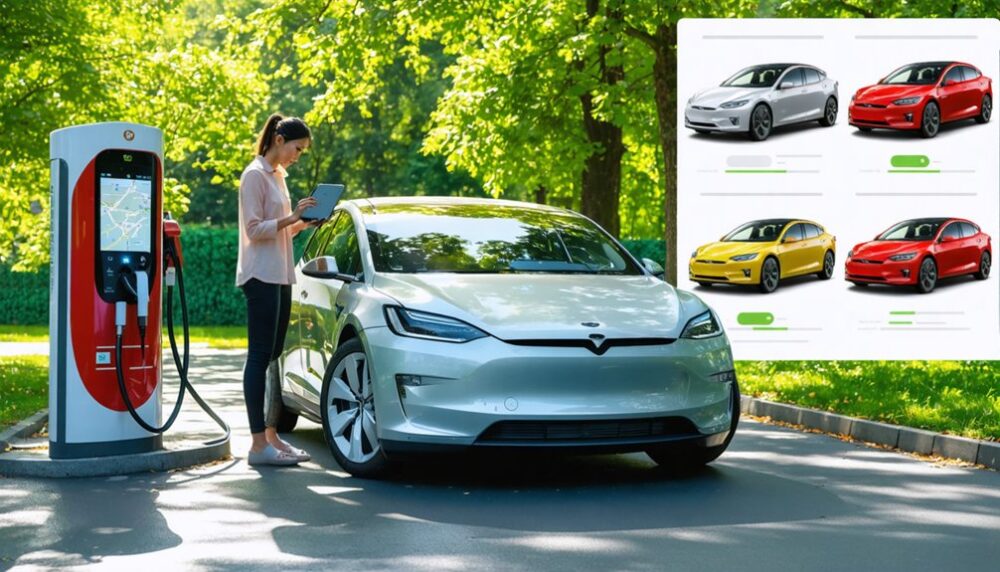

Choosing the best electric vehicle (EV) involves evaluating several key factors. First, understand your driving range needs. Evaluate budget considerations, including potential incentives. Charging infrastructure availability is vital for convenience. Consider vehicle size for practicality, especially for families. Performance characteristics should align with personal preferences, while brand reliability plays a significant role in satisfaction. Finally, examine future-proofing features, such as advanced technology and over-the-air updates, to guarantee your choice remains relevant for years to come. More perspectives await.
Highlights
- Assess your daily driving habits and range requirements to ensure the EV meets your needs, ideally with a buffer of 20-30% for peace of mind.
- Consider vehicle size and cargo capacity, especially for families, as purpose-built EV designs often provide better usability and comfort.
- Evaluate charging options available in your area, prioritizing Level 2 or DC fast chargers for quicker and more convenient charging experiences.
- Factor in budget considerations, including federal and state incentives, and explore the rising used EV market for cost savings.
- Research brand reliability and service records to ensure long-term satisfaction and ease of maintenance with your chosen electric vehicle.
Understanding Your Range Requirements
Understanding the intricacies of range requirements is essential for prospective electric vehicle (EV) owners. Accurate range estimation is crucial, particularly as the average UK commute is around 15-30 miles a day, while typical single-vehicle households can drive approximately 50 miles daily.
Most families find their local driving seldom exceeds 70-80 miles. Consequently, modern EVs, with their average ranges of 200-300 miles per charge, often meet these needs comfortably. However, various factors such as battery capacity, driving style, and even weather conditions can impact efficiency. To avoid range anxiety, potential owners should track their driving habits and add a buffer of 20-30% to guarantee their new EV accommodates all daily commutes, including unexpected detours. Most UK journeys are under 25 miles, making a 200-mile range more than sufficient for daily driving needs. Additionally, some high-end models boast ranges exceeding 400 miles on a single charge, offering even more peace of mind for long trips. Understanding how temperature impacts EV range is essential to optimize daily usage, especially in regions with extreme weather conditions.
Evaluating Price Considerations
Evaluating price considerations is a crucial step for anyone looking to purchase an electric vehicle (EV) in today’s diverse market. Budget planning should encompass the full range of options, from entry-level choices like the Nissan Leaf to mid-range models such as the Ford Mustang Mach-E. Cost analysis reveals attractive alternatives; vehicles under $40,000 can offer over 300 miles of range, representing significant value. Moreover, the rising used EV market provides opportunities for budget-conscious consumers, often at 40-50% less than new models. With manufacturers introducing even more affordable options projected to reach below $20,000 by 2030, it’s essential for potential buyers to weigh their financial boundaries carefully as they plunge toward sustainable transportation. Additionally, the cheapest new EV in 2025 with over a 300-mile range is the Ford Mustang Mach-E Premium, priced at $39,995, making it a competitive choice for budget-conscious buyers. Notably, several of the 2025 electric vehicles listed have a base price of under $50,000, broadening the options for consumers. With impressive ranges available, many EVs like the Citroen e-C3 are among the cheapest options to consider.
Assessing Charging Infrastructure
An essential aspect of shifting to electric vehicle (EV) ownership is the accessibility and reliability of charging infrastructure. Potential EV owners must consider the types of charging stations available, as they can vary substantially in speed and requirements. Level 1 chargers, while convenient for home use, require long charging times. Level 2 chargers, found in residential and commercial settings, offer faster charging and are ideal for daily use. Meanwhile, Level 3 DC fast chargers, placed strategically along busy routes, enable rapid recharging. DC fast charging typically provides charging speeds of 50 kW to 150 kW, catering to a range of EVs. A robust network of charging stations is necessary to meet the rising demand for EV infrastructure. The choice between chargers is influenced by power availability, which is crucial for selecting chargers that deliver solutions that are reliable, effective, and safe.
Infrastructure development is vital to guarantee these charging stations meet growing demand. With advancements promoting compatibility and expanding locations, belonging to the thriving EV community becomes accessible and enjoyable for all individuals seeking sustainable transportation solutions.
Considering Vehicle Size and Practicality
When selecting an electric vehicle (EV), considering the size and practicality of the model is essential for ensuring it aligns with personal needs and lifestyles. Vehicle dimensions play a pivotal role in determining comfort and usability, particularly for families. For example, the Kia EV9 offers an impressive 828 liters of cargo capacity with seats up, expandable to 1,650 liters when the seats are folded. Unlike traditional vehicles, purpose-built EV platforms excel in maximizing interior space, making them more versatile than converted models like the Genesis Electrified G80. Additionally, large SUVs, such as the Volvo EX90, often feature flexible seating configurations that enhance passenger comfort while maintaining ample cargo capacity, resulting in a harmonious blend of practicality and family-friendly design. The Hyundai IONIQ 7 is also designed to provide exceptional space and versatility as a 7-seater vehicle. Many modern electric cars have a real-world range that exceeds 200 miles, which can influence the choice based on travel needs. Notably, the Tesla Model Y has a total luggage capacity of 971 / 2,158 litres, making it one of the most spacious electric SUVs available.
Analyzing Performance Characteristics
Understanding the performance characteristics of electric vehicles (EVs) is essential for consumers seeking a model that meets their specific driving needs. EV range varies substantially, with most models exceeding rated range under ideal conditions, but dropping to as low as 54% in extreme cold. Battery capacity plays a pivotal role in determining range, with options ranging from 40-100+ kWh. Powertrain configurations also affect electric performance; dual-motor setups offer instant torque and rapid acceleration. Moreover, the efficiency of charging systems is indispensable, as charging speeds can slow dramatically outside ideal temperature ranges. For example, many long-range EVs, such as the Volkswagen ID.7 Pro S, can achieve an impressive range of 475 miles, making them suitable for long-distance travel without frequent charging stops. In addition, the introduction of the 2026 Polestar 3‘s new rear motor and upgraded architecture demonstrates how advancements in technology can further enhance performance and charging efficiency. Furthermore, considering that all-electric vehicles produce zero tailpipe emissions, choosing an EV also contributes to reducing your carbon footprint.
Consumers should consider these factors to choose an EV that aligns perfectly with their lifestyle and performance expectations, enhancing their driving experience.
Investigating Brand Reliability and Service
Evaluating performance characteristics is only one aspect for consumers considering electric vehicles; brand reliability and service quality also weigh heavily on their purchasing decisions. Industry standards from Consumer Reports and J.D. Power provide numerical scores and rankings that help potential buyers assess reliability. The BMW i4, for instance, stands out with an impressive reliability score of 82. Despite advancements, common reliability challenges remain, including battery degradation and software malfunctions. Additionally, consumers should consider the EPA Est. Range of various models when making their choice, as this can impact overall satisfaction and usability. Consumers should also investigate service options and maintenance costs, as specialized components can lead to higher repair expenses and extended service timelines. Reliable parts are crucial to keeping EVs running smoothly, and an informed choice about brand reliability will not only enhance the ownership experience but promote a sense of community among like-minded EV enthusiasts. Moreover, many automobile owners actively participate in community discussions to share valuable insights about their experiences with different models.
Identifying Your Driving Needs
Identifying driving needs is crucial for anyone contemplating the shift to an electric vehicle (EV). Understanding daily routines and driving habits is essential, as this will guide the selection of the most suitable EV.
For instance, an analysis of typical mileage, including urban stop-and-go versus highway driving, can substantially influence range requirements. Vehicles that cover 100-300 miles daily are often prime candidates for battery electric vehicle (BEV) adoption. Additionally, factors such as terrain, temperature extremes, and vehicle load must be considered, as they affect energy consumption and range. Fleets should evaluate their duty cycles to determine the best EV models for their applications.
With the rapid proliferation of electrification, consumers can expect that global EV sales will significantly rise by 2040, influencing their vehicle choices today. Tracking these elements over 6-12 months allows for a clearer image of actual needs, ensuring that the chosen EV aligns seamlessly with lifestyle requirements and driving preferences, which is essential.
Examining Available Incentives and Tax Credits
When considering the shift to an electric vehicle (EV), potential buyers should pay close attention to the various incentives and tax credits available.
Federal incentives offer a significant advantage, with a tax credit up to $7,500 for new EVs and $4,000 for used vehicles purchased before September 30, 2025.
To qualify, the vehicle must be assembled in North America, and specific price limits and buyer income thresholds apply.
Additionally, many states offer state credits that can further reduce the overall cost and may include rebates and other perks.
It’s also essential to remember that binding purchase agreements must be established prior to the deadline to guarantee eligibility and maximize savings when switching to an EV.
Exploring Future-Proofing and Technology Features
As electric vehicles (EVs) continue to evolve, potential buyers are increasingly focused on future-proofing their investments by prioritizing advanced technology features. Modern EVs showcase impressive battery technology, with ranges exceeding 400 miles becoming commonplace by 2025.
Smart features such as over-the-air software updates allow for seamless connectivity, enhancing user experience and safety. The integration of advanced driver assistance systems, including semi-autonomous driving capabilities, reflects a commitment to innovative technology.
Additionally, charging infrastructure is rapidly expanding, with 250-kilowatt DC fast chargers available more widely. With cinematic displays and premium infotainment systems, these vehicles cater to tech-savvy consumers, ensuring that they remain both relevant and enjoyable to drive in an increasingly connected world.
References
- https://www.go-electra.com/en/newsroom/best-electric-cars-in-2025/
- https://coltura.org/electric-car-battery-range/
- https://afdc.energy.gov/vehicles/search/download.pdf
- https://www.caranddriver.com/rankings/best-electric-cars
- https://www.edmunds.com/electric-car/
- https://www.consumerreports.org/cars/types/new/hybrids-evs/
- https://www.electriccarscheme.com/blog/how-much-electric-car-range-do-you-need-2025-guide
- https://pluginamerica.org/faq/do-evs-have-enough-range-to-meet-my-daily-driving-needs/
- https://ev-lectron.com/blogs/blog/how-far-can-my-ev-go-on-one-charge
- https://www.geotab.com/blog/ev-range/