

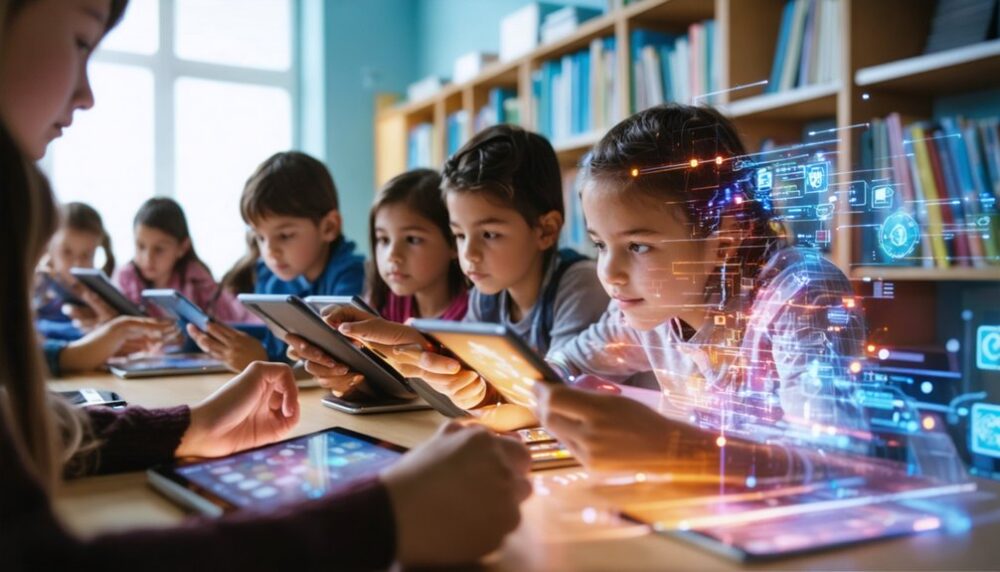

AI personalizes student tutoring by analyzing individual performance data to create customized learning pathways. Adaptive technologies enable real-time feedback and interactive assessment, allowing students to engage at their preferred difficulty levels. Techniques such as advanced natural language processing deliver situation-specific responses, enhancing interactivity and retention. Personalized learning experiences substantially improve student outcomes, with engagement metrics showing notable increases. Exploring the latest advancements in AI can reveal even more impactful strategies for educational enhancement.
Highlights
- AI analyzes student performance data to create customized learning pathways, enhancing individual learning experiences.
- Advanced natural language processing enables AI chatbots to deliver context-specific support tailored to student needs.
- Personalization allows students to select preferred difficulty levels and topics, promoting ownership of their learning journey.
- Real-time feedback and adaptive assessment provide immediate corrections and guidance, enhancing engagement and improving outcomes.
- AI tutoring systems facilitate learning beyond classroom hours, ensuring equitable access to personalized education for all students.
The Evolution of AI Tutoring Systems
As artificial intelligence began to emerge in the mid-20th century, its application in education initiated a revolutionary voyage in tutoring systems. The AI origins can be traced back to Alan Turing’s crucial questions about machine intelligence and the 1956 coining of the term “artificial intelligence,” which spurred research into machine reasoning capabilities. A significant milestone came with PLATO in the 1960s, introducing interactive lessons and adaptive learning. The 1970s heralded the first generation of Intelligent Tutoring Systems (ITS), like SCHOLAR, which relied on algorithm development to adapt instruction based on student logic and responses. AI-powered tutors have since become instrumental in providing personalized lessons and instant feedback, enhancing the overall learning experience. Today, a vast majority of students rely on AI tools, with 92% using some form of AI in their educational journey. AI supports content creation for various comprehension levels, further enriching the customization of tutoring experiences.
Personalization Techniques in AI Tutoring
The integration of personalization techniques in AI tutoring has revolutionized the educational scenery, allowing for customized learning experiences that cater to individual student needs. By employing data-driven learning path adaptation, intelligent mentors analyze student performance to create customized pathways, predicting obstacles and adjusting materials accordingly. AI chatbots utilize advanced natural language processing to deliver situation-specific responses aligned with educational structures, such as Vygotsky’s Zone of Proximal Development. Additionally, AI tutoring systems facilitate learning beyond traditional classroom hours, promoting equitable access to quality education. Student-controlled learning parameters promote a sense of ownership, enabling learners to select their preferred difficulty levels and topics. Through interactive techniques, like role-play and Socratic questioning, AI tutors engage students energetically, enhancing understanding and retention. These innovations promote an inclusive environment that champions personalized, effective learning paths, helping to reduce teacher pressure by allowing AI to handle certain aspects of instruction. Moreover, AI tutors enhance self-directed learning by adapting lessons to each student’s interests and pace, which fosters independent exploration and a deeper understanding of the material.
Impact of Personalization on Student Performance
While many factors contribute to educational success, the impact of personalization on student performance has become increasingly evident in AI tutoring environments. Personalized learning facilitated by adaptive technology has shown outstanding effectiveness, with mean post-test scores rising from 68.2 to 80.4 in personalized groups across grades 6-12. Moreover, AI-driven tutoring systems improve learning outcomes by 24% and enhance engagement, as evidenced by a 54% increase in course participation among students using these tools. Particularly, high-engagement learners exhibit substantially improved performance, with effect sizes reaching 0.92 for correct answers per minute. Additionally, the positive effects of ITSs can lead to significant learning gains, providing a robust framework for further implementation. Predictive analytics also allow for timely interventions, supporting at-risk students, as the site administrator can be contacted to address specific challenges faced by learners. These systems are designed to offer personalized learning experiences, ensuring that instruction is tailored to individual student’s unique needs.
Market Growth and Adoption of AI Tutoring
With the rapid evolution of technology, the AI tutoring market is witnessing unparalleled growth and adoption across the globe. Market analysis reveals projections for the AI tutoring services sector, valued at approximately $3.7 billion in 2025, rising to over $21 billion by 2035. This reflects an extraordinary 481% growth rate. In the U.S., significant adoption is evident, with market generation expected to climb from $367 million in 2024 to nearly $1.5 billion by 2030. Industry trends indicate that pure AI tutoring solutions will maintain dominance, constituting over 59% of the market share. Factors driving this expansion include increasing digital engagement among students and educators, solidifying AI’s role as an essential tool in modern education and personalized learning environments. Additionally, the demand for scalable personalization in learning is a significant growth driver for the AI Tutoring Services Market. Moreover, the increasing popularity of personalized learning experiences contributes to making education more inclusive and effective. Furthermore, increased internet access has contributed to the widespread adoption of AI tutors, especially in regions with previously limited educational resources.
Enhancing Student Engagement With AI Tutors
AI tutors have emerged as powerful tools for enhancing student engagement in educational settings. Research indicates that AI benefits include improved engagement ratings of 4.1/5 compared to 3.6/5 in traditional classrooms. An adaptive approach, using personalized pacing mechanisms, sustains attention by aligning challenge levels with individual student capabilities. This results in 70% of students completing sessions within one hour, reflecting self-regulated engagement. Additionally, motivational reinforcement systems offer individualized feedback and clear next-step guidance, crucial for maintaining interest and ensuring positive student outcomes. Recent research conducted at Harvard University indicates that AI tutoring can significantly enhance learning outcomes. This innovation in education extends the potential for growth by leveraging AI-powered pedagogy to address diverse student needs effectively. Moreover, the integration of data-driven insights from AI allows for real-time adjustments to tutoring strategies that further engage students.
The collaborative efforts of teachers and AI further optimize engagement, allowing instructors to focus on relationship-building while leveraging real-time analytics. Ultimately, AI tutoring demonstrates considerable potential to enhance student motivation and engagement effectively.
Real-Time Feedback and Its Importance
The importance of real-time feedback in educational environments cannot be overstated. AI-powered systems provide immediate correction and adaptive assessment, delivering tailored suggestions and explanations as student responses are evaluated. This dynamic interaction helps prevent misconceptions by addressing errors while the material is still fresh, leading to enhanced understanding and retention. Research shows that students receiving real-time feedback achieve 54% higher test scores compared to traditional methods, making a compelling case for its implementation. Furthermore, these intelligent tutoring systems continuously monitor performance data, recommending immediate next steps based on individual patterns. This swift feedback cycle promotes continuous improvement and engagement, ultimately cultivating an enriching academic experience that empowers students and fosters a supportive learning community. Additionally, real-time feedback supports deeper learning and improves outcomes by simulating interactive dialogue similar to a great teacher. Given the potential of Intelligent Tutoring Systems (ITS), the integration of AI to facilitate this feedback becomes increasingly crucial in personalized learning environments. Moreover, personalized AI learning can improve student outcomes by up to 30%, further underscoring the value of timely and relevant guidance in educational settings.
Addressing Educational Inequities Through AI
Addressing educational inequities presents a crucial challenge in contemporary learning environments, particularly as technology continues to shape the educational terrain. AI’s potential to enhance educational equity is hindered by socioeconomic barriers that underrepresented students face. A substantial number of first-generation students exhibit low confidence in AI use and often lack access to essential resources. Moreover, 58% of students report insufficient AI knowledge, revealing a gap in literacy across diverse populations. To combat these disparities, higher education institutions are increasingly recognizing the importance of customized AI literacy initiatives, which can markedly improve confidence and skills among marginalized students. Effective policy structures promoting equitable AI implementation are essential to guarantee that technology benefits all learners, nurturing a more inclusive educational ecosystem. In fact, 92% of UK students now utilize AI in some form, highlighting the urgent need for educational institutions to adapt to this technological shift. Furthermore, 80% of students worldwide have used generative AI to support their university studies, indicating a growing trend that institutions must leverage to bridge digital gaps.
The Role of AI in Improving Learning Outcomes
In recent years, the integration of advanced tutoring systems has revolutionized educational landscapes, substantially enhancing learning outcomes for diverse student populations. AI-driven platforms offer personalized academic support, improving performance metrics by 24% and retention rates by 30%. Through real-time analysis, students receive customized content that addresses individual strengths and gaps, cultivating a customized learning experience.
This adaptability reduces academic stress and maintains engagement, with 54% of users reporting increased coursework involvement. Moreover, early identification of at-risk students allows for targeted interventions, ensuring timely support. By enhancing student motivation through relevant content and immediate assistance, AI not only optimizes learning paths but also nurtures a sense of belonging within the educational environment, ultimately changing the landscape of scholarly experiences to plunge into deeper understanding and promote a culture that supports growth, thus helping to plunge, or rather, transition and develop the educational world, and in addition, change the educational scene.
Future Trends in AI-Powered Tutoring Systems
Future trends in AI-powered tutoring systems promise to reshape educational experiences substantially.
Market projections indicate significant growth, with the AI education sector anticipated to expand from $7.57 billion in 2025 to $112.30 billion by 2034.
Concurrently, the integration of emotionally intelligent tutoring systems, employing biometric data to gauge student engagement, is redefining responsiveness in education.
Enhanced teacher-AI collaboration models will facilitate ideal learning environments, ensuring human oversight in decision-making, thereby addressing AI ethics concerns.
Open-source platforms are gaining traction, enabling customizability and mitigating vendor dependency.
As organizations invest heavily in these innovations, promoting a balance between advanced technology and human perspectives will be vital for creating meaningful educational experiences that harmonize with diverse learning communities.
References
- https://pmc.ncbi.nlm.nih.gov/articles/PMC12078640/
- https://www.grandviewresearch.com/industry-analysis/ai-tutors-market-report
- https://www.aiprm.com/ai-in-education-statistics/
- https://www.weforum.org/stories/2024/07/ai-tutor-china-teaching-gaps/
- https://www.norc.org/research/library/unlocking-hearts-and-minds-transformative-power-of-ai-enhanced-high-dose-tutoring.html
- https://www.park.edu/blog/ai-in-education-the-rise-of-intelligent-tutoring-systems/
- https://www.nature.com/articles/s41598-025-97652-6
- https://standtogether.org/stories/education/how-ai-personal-tutors-are-re-shaping-education
- https://elearningindustry.com/the-history-of-ai-elearning-edition
- https://community.macmillanlearning.com/t5/learning-stories-blog/ai-in-the-classroom-what-the-history-the-data-and-students-are/ba-p/23558